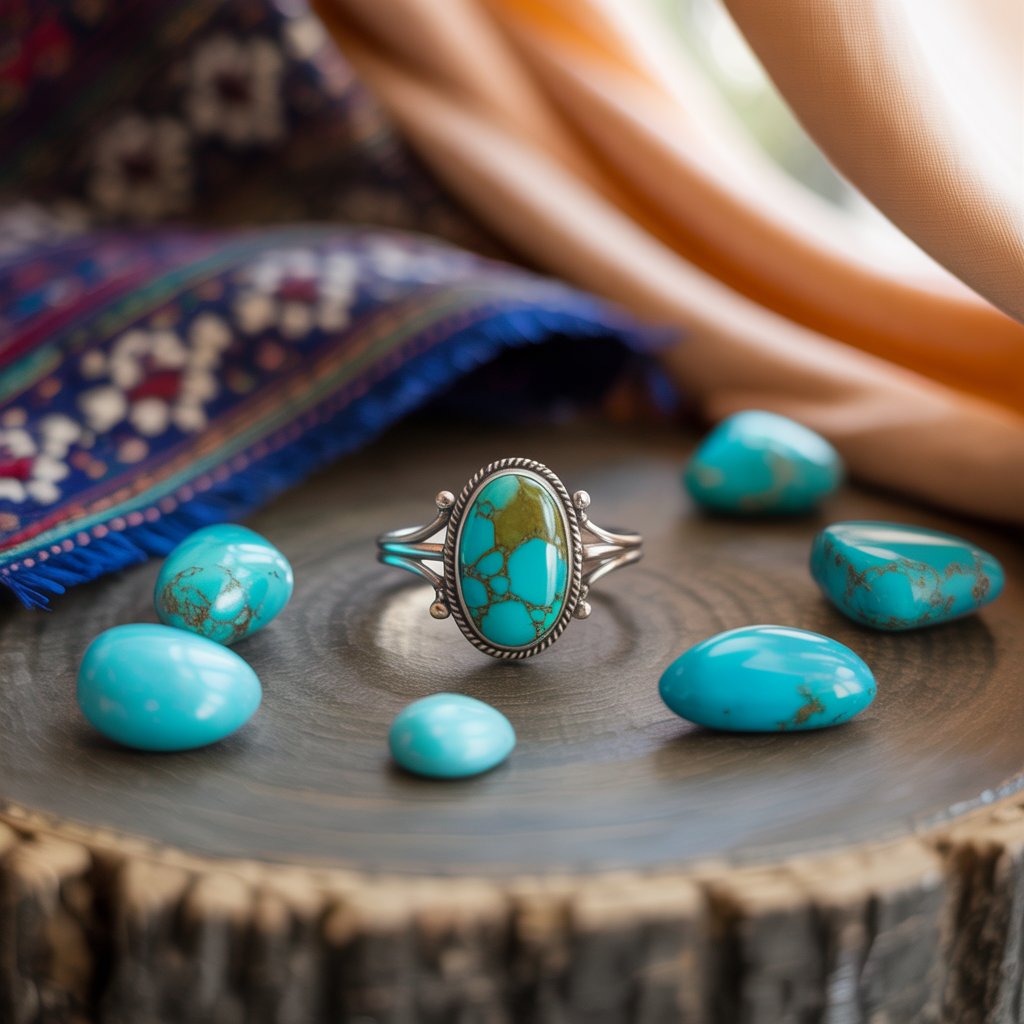
Natural Turquoise (Feroza): The Complete Guide to This Ancient Gemstone

The Sky Stone Through the Ages

Natural turquoise, known as Feroza in Persian, Urdu, and Hindi, is one of humanity’s oldest and most cherished gemstones. For over 7,000 years, this captivating blue-green stone has adorned pharaohs, emperors, and spiritual seekers across civilizations. From the burial mask of Tutankhamun to Native American ceremonial jewelry, turquoise has maintained its status as a stone of protection, healing, and spiritual significance.

If you’re searching for information about natural turquoise or Feroza stone, whether for its aesthetic beauty, astrological properties, or investment potential, this comprehensive guide will help you understand everything you need to know about this remarkable gemstone.

What is Natural Turquoise (Feroza)?

Chemical Composition and Formation

Scientific Profile: Turquoise is a hydrated phosphate of copper and aluminum with the chemical formula CuAl₆(PO₄)₄(OH)₈·4H₂O. This unique composition gives turquoise its distinctive blue-green coloration:

  • Copper content creates the blue color
  • Iron presence produces greener hues
  • Aluminum and phosphate form the base structure
  • Water molecules are incorporated into the crystal structure

How Turquoise Forms

Natural turquoise forms through a complex geological process:

  1. Copper-rich water percolates through aluminum and phosphate-bearing rocks
  2. Chemical reactions occur over millions of years
  3. Secondary mineral deposits form in fractures and cavities
  4. The result is turquoise veins and nuggets with characteristic matrix patterns

The Name “Feroza”

The term Feroza (also spelled Firoza or Firoze) comes from Persian, meaning “victorious” or “turquoise blue.” In South Asian and Middle Eastern cultures, this name carries deep cultural and spiritual significance, reflecting the stone’s valued status in these regions.

Types and Origins of Natural Turquoise

Persian Turquoise (Neyshabur)

The Gold Standard: Persian turquoise from the Neyshabur mines in Iran is considered the finest in the world.

Characteristics:

  • Sky-blue to robin’s egg blue color
  • Minimal to no matrix (webbing)
  • Uniform, even color distribution
  • Hard and dense structure
  • Natural, untreated quality

Historical Significance: These mines have been producing turquoise for over 2,000 years and supply what many consider the most valuable turquoise in the market.

American Turquoise

Sleeping Beauty (Arizona):

  • Pure, solid blue color
  • No matrix or minimal webbing
  • Highly sought after for its clean appearance
  • Mine closed in 2012, making existing stones more valuable

Kingman (Arizona):

  • Bright blue with distinctive brown or black matrix
  • Excellent hardness
  • Popular for contemporary jewelry

Royston (Nevada):

  • Rich green to blue-green colors
  • Beautiful brown matrix patterns
  • Highly collectible

Bisbee (Arizona):

  • Deep blue with reddish-brown to chocolate matrix
  • Historic mine (now closed)
  • Premium prices for quality specimens

Chinese Turquoise (Hubei Province)

Growing Prominence:

  • Wide color range from blue to green
  • Often features attractive matrix patterns
  • More affordable than Persian or premium American stones
  • Significant presence in today’s market

Egyptian Turquoise

Historical Importance:

  • One of the oldest known sources (Sinai Peninsula)
  • Greenish-blue color
  • Historically significant but limited modern production